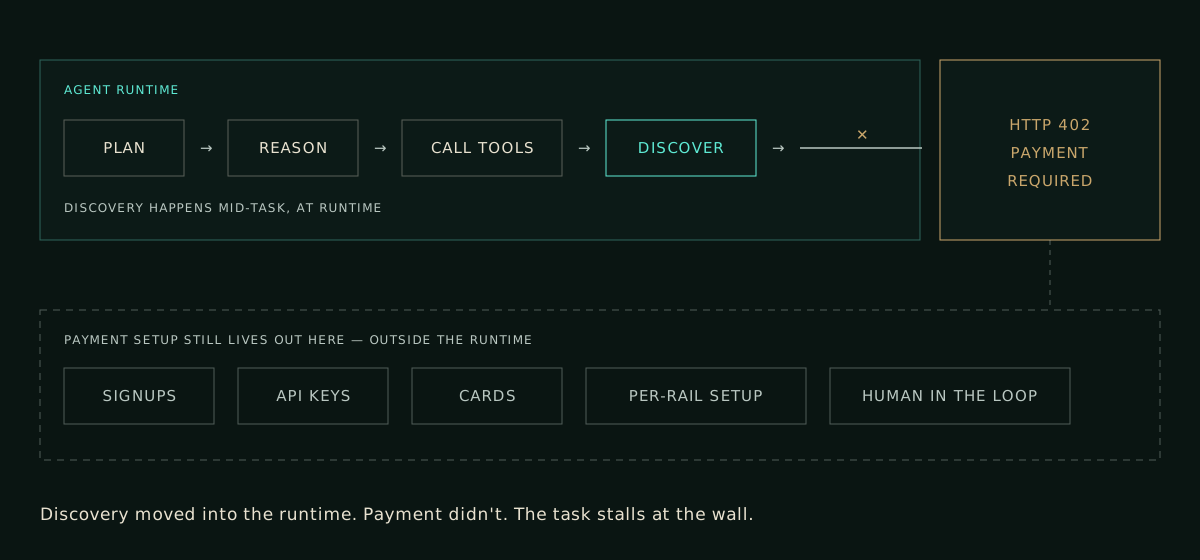
AI agents break at payment because API access moved into the runtime and payment didn't. An agent discovers a paid service mid-task, hits HTTP 402 Payment Required, and has nowhere in its runtime to put a payment: no payment surface, no shared credentials, no unified liquidity.
Watch an autonomous agent work and it's impressive right up until it isn't. It plans, it reasons, it calls tools, it chains steps. Then the task crosses a paywall — a paid dataset, a metered API, a unit of compute it doesn't already have access to — and the whole thing seizes. The agent that just navigated a ten-step workflow can't get past a single 402. This isn't a model problem; the reasoning is fine. It's an infrastructure problem. Your agent stops where payment starts.
Why can't agents just use API keys?
For twenty years, accessing an API meant a human did setup work once: sign up, get a key, store it, wire it into the app. Agents inherited that model and it doesn't fit them.
An autonomous agent can't sign up for accounts. It can't juggle a pile of API keys without becoming a liability the first time one leaks. It can't enter a credit card or click "subscribe." And critically, it discovers what it needs at runtime — it doesn't know in advance which services it'll call, so there's no setup moment to pre-arrange access in.
The result is a structural gap. Discovery moved into the agent's runtime; payment didn't. Three things are missing the moment a task needs to pay:
- No runtime payment surface. Agents spend at runtime, but payment setup still lives outside the agent workflow.
- No shared credential envelope. Every service wants its own key, stored its own way. That doesn't compose for a thing calling dozens of services it's never seen.
- No unified liquidity path. Even once an agent can pay, it has to fund and reconcile across separate rails that don't know about each other.
What did HTTP 402 standardize, and what stayed fragmented?
The good news of 2026 is that the industry agreed on how to ask for payment. HTTP 402 Payment Required — reserved since the 1990s — became the spine of machine-native charges. Coinbase has reported 160M+ x402 agentic transactions; treat that as a protocol-volume figure, not a measure of genuine commercial demand. Coinbase, Stripe, Visa, Mastercard, Google, and Circle have all shipped agent-payment schemes.
The bad news is that they standardized the challenge and fragmented the settlement. Credentials, liquidity, and settlement now scatter across Circle Gateway, x402, MPP, and a queue of adjacent commerce protocols (ACP, UCP, AP2) plus agent-to-agent messaging (A2A). So "agents can pay" quietly became "agents can pay, if they re-implement every rail, and re-implement the next one next quarter."
For a builder, that's the worst kind of gap: not a wall you can't climb, but a tax that grows every time you ship.
What does closing the gap actually require?
If the problem is "payment doesn't live in the runtime," the fix isn't a better wallet or a faster chain. It's a payment surface that exists where the agent already is — one that turns "this task needs to pay" into a single runtime call, and absorbs the rail fragmentation so the agent never sees it.
Concretely, that means three things the agent should not have to do itself:
- Discover and price a service it didn't know about a second ago.
- Translate credentials so one signature satisfies whatever scheme the merchant uses.
- Orchestrate settlement — choose the rail, move the money, reconcile — across protocols that don't coordinate.
This is the job SELAT takes off the agent's plate. Discover, fund Circle Gateway, pay USDC from the user's Circle Agent Wallet. The agent signs one shape; SELAT resolves discovery, authorization, settlement, and reconciliation. SELAT never holds keys or funds. The payment surface moves into the runtime, where the gap was.
selat run "search the web for recent papers on agentic payments"
selat run spends unless you pass --dry-run. That's the whole point: the agent expresses intent, and getting from intent to a paid result stops being the step where everything breaks.
Why is this the interesting problem in agentic commerce?
It's tempting to treat payments as plumbing — necessary, unglamorous, solved-enough. But the agents people actually want don't just answer questions; they do things, and doing things in the real world almost always costs money somewhere in the chain. An agent that can't reliably cross a paywall is an agent that can only ever operate in the free tier of the world.
Closing the runtime payment gap is what turns autonomy from a demo into a workflow. The reasoning was never the bottleneck. Payment was.
What's the real unit of work: the payment or the skill?
There's a reframe hiding at the end of this. When an agent does real work, it rarely crosses a single paywall — it runs a skill: a multi-step workflow that might hit a search API on one rail, a scraper on another, a model behind a third. Solving payment per call is necessary, but it's not the destination. What the runtime actually needs is cross-rail composition: every endpoint a multi-step skill calls paid — across whatever rails they live on — from a single self-custody balance, in one execution. Each merchant is paid directly, at its live quote, on its own rail, per call, with every call drawing on one Circle Agent Wallet, under one set of spending caps, reconciling into one ledger.
That's a bigger idea than a payment surface. Registries solved how skills get listed — distribution is free and it works. Nothing underneath them solved how a skill gets settled. Closing the runtime payment gap is step one; the rest is where this is all headed.
If you're building agents that need to transact, the builder's-eye view of the same territory is how AI agents pay for APIs. Start with llms.txt, or compare the protocols in x402 vs MPP.
FAQ
Why do AI agents break at payment?
Because they discover services at runtime but still lack a payment surface in that same runtime. HTTP 402 Payment Required is a well-specified challenge; funding, credentials, and settlement are not one path.
What is a runtime payment surface?
A way to turn "this task needs to pay" into a single in-workflow call: discover, quote, apply spending caps, pay, return the resource. Without it, the agent has to leave the task and wait for a human to provision a key or a card.
How does SELAT close that gap?
Discover → fund Circle Gateway → pay USDC from the user's Circle Agent Wallet. selat run does that path and spends unless you pass --dry-run. SELAT never holds keys or funds. Hosted discovery at https://catalog.selat.ai/mcp is search and quotes only.
Is HTTP 402 enough by itself?
No. HTTP 402 standardizes the ask. Merchants still settle on different rails. The agent still needs one wallet, one policy, and one way to pay whoever answered the 402.